A4G Impact Collaborative
AI for Mental Well-Being
AI for Mental Well-Being
We stay.
Featured Work
The Lumina Platform
We are building India's first AI-augmented mental well-being system for the population losing its job to AI, bridging the critical gap in clinical capacity.
Our angle
A4G is not a clinic and not a training institute. We are a small, specific kind of thing. A collective that looks at the psychological shape AI is giving to a generation losing its first professional foothold, and builds the tools and pathways to hold that generation while a new working life is found.
We are building Lumina, an AI-augmented mental well-being platform for the AI-displaced cohort. We publish thought-leadership work like Aarti's chair essay.
The pillar is led by Aarti Ahuja (clinical anchor and author of the foundational essay) with Nitin Dhawan (co-founder). Advising it are Dr. Mahesh Prasad, National Awardee (President of India), founder of Aarohan Consulting, PhD in Psychology, and forty-year leader of some of the most prestigious schools in the country; and Dr. Sangeeta Trehan, Professor and multi-disciplinary academician, AI-for-Good practitioner.
Our work - Lumina Platform
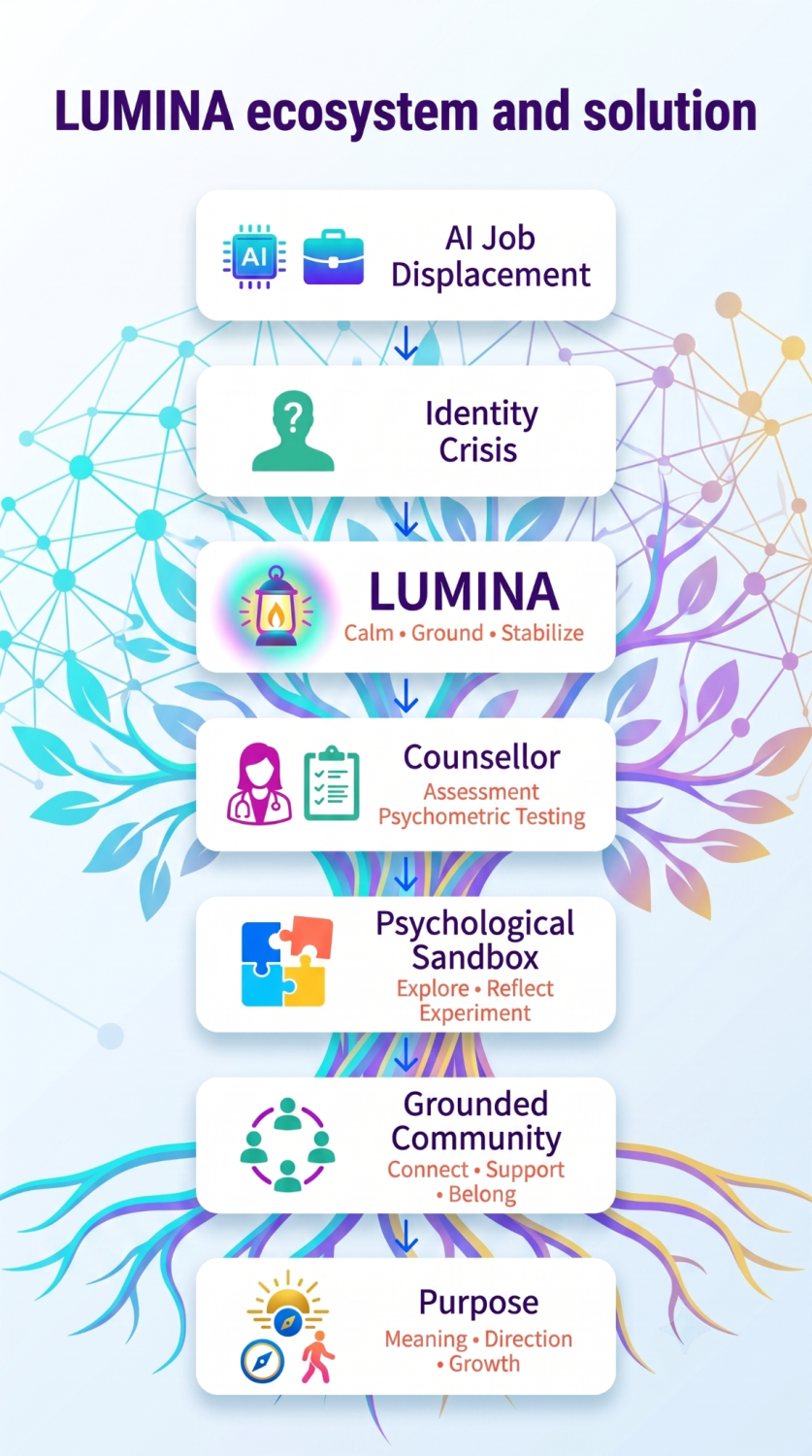
Lumina is the ecosystem we are building. India's first AI-augmented mental well-being system for the population losing its job and often its sense of self because of AI. Everything below sits inside Lumina as one system.
A training programme for psychologists.
India does not have clinicians trained to hold the specific shape of algorithmic grief. Lumina will train them in the psychology of AI displacement and the identity rupture that follows losing one's designation.
An online ecosystem of psychologists at scale.
Thousands of psychologists reachable online through Lumina, so that a person losing a job at eleven at night can find a trained human within minutes rather than months, from anywhere in the country.
An AI-based first-response system.
The front door of Lumina. What Priya opens on her laptop at the kitchen table. It calms and stabilises in the first hours, then hands the person to a trained counsellor when the moment is ready.
A career support system built into the first response.
The wound sits in the mind and in the working life. Lumina builds career counselling directly into the first-response layer so that a person moves from grief to grounded direction.
The Swadharma research.
The interpretive layer of Lumina. Draws on Panchakosha and Indic frameworks of svadharma (the calling that is authentically one's own), integrated with the parts of Western clinical practice that can be honestly combined with them.
The A4G Mental Well-Being Fellowship.
The research and clinical team behind everything above. Fellows will come from doctoral programmes in clinical psychology and career counselling, and from mid-career institutional practice.
Several longitudinal studies will run alongside this work.
How to collaborate
The five-to-seven year window is real. The mental-health design work must happen now, alongside the governance work, not after.
We invite clinical psychologists, academic researchers, and partner clinics to co-design the Swadharma curriculum or join our longitudinal studies. Reach out to join our community networks or review clinical insights.
Before a person can be reskilled, they must be re-found. The tsunami does not ask permission. Neither does survival. We stay.- Aarti Ahuja